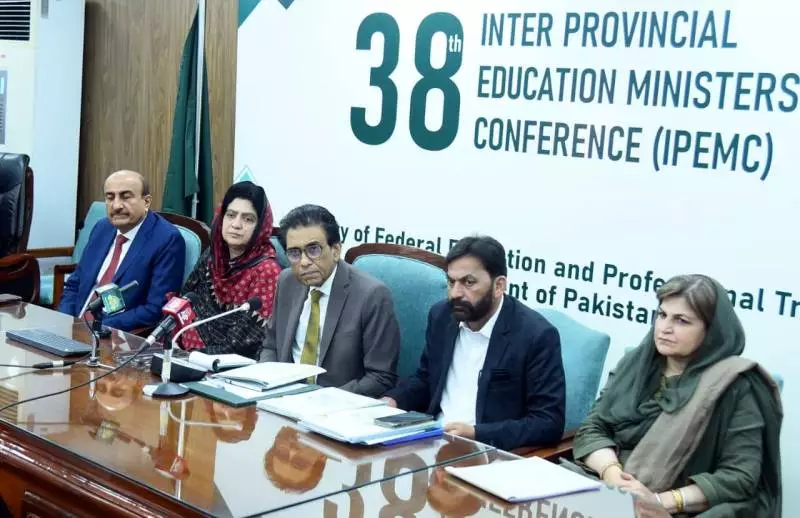
In a landmark display of national unity, Pakistan's federal and provincial governments have joined forces to declare an education emergency. The 38th Inter-Provincial Education Ministers Conference (IPEMC), held recently, resulted in the unanimous approval of a comprehensive National Education Emergency Action Plan. This plan is specifically designed to tackle the critical issue of out-of-school children (OOSC) and implement sweeping educational reforms across the country.
A Historic Consensus for Education
Chaired by Federal Minister for Education and Professional Training Khalid Maqbool Siddiqui, the high-level meeting saw participation from all administrative units. Key attendees included Minister of State for Education Wajiha Qamar, Federal Parliamentary Secretary Farah Naz Akbar, and Secretary Education Nadeem Mahbub. Provincial representation was strong, with Rahila Hameed Durrani (Balochistan), Muhammad Ismail Rahoo (Sindh), Rana Iqbal Sikandar (Punjab, via video link), and Arshad Ayub Khan (Khyber Pakhtunkhwa, via video link) in attendance. Notably, political differences were set aside to achieve a consensus on this national crisis.
The conference endorsed a special federal 'Challenge Fund' aimed at supporting provincial efforts to bring children back to school. Federal Minister Siddiqui hailed the conference as a milestone of national harmony, emphasizing that the collective gathering symbolized a firm commitment to overcoming Pakistan's educational challenges.

Provincial Progress and Pledges
During the session, provincial ministers presented significant updates on their respective education drives:
- Punjab: Education Minister Rana Sikandar reported the elimination of 1.8 million ghost students from school records and the outsourcing of 10,000 schools to improve management.
- Sindh: Minister Muhammad Ismail Rahoo confirmed the merit-based recruitment of a massive 93,000 teachers to strengthen the teaching workforce.
- Balochistan: Minister Rahila Hameed Durrani announced the restoration of 3,200 previously closed schools, successfully bringing 140,000 children back into the classroom.
- Khyber Pakhtunkhwa: The province confirmed a 6% increase in student enrollment and the recruitment of 10,000 new teachers.
- Azad Kashmir: Minister Malik Zafar highlighted the allocation of 7 billion rupees for the construction of 10,000 new classrooms, despite challenges along the Line of Control.
- Gilgit-Baltistan: Initiatives were shared regarding special funds for out-of-school children and an expansion of the 'School Meal Program'.
Roadmap for Reform and National Alignment
The National Action Plan, as briefed by DG PIE Dr. Muhammad Shahid Saroya, was the result of six months of extensive stakeholder consultations. It directly addresses the challenge of an estimated 25 million out-of-school children in Pakistan.
Federal Secretary Education Nadeem Mahbub stated that all approved projects will receive final ratification from the Prime Minister-chaired 'Education Emergency Task Force'. He urged provinces to benefit from the Federal Board's reform program and stressed the need to align Matric and Inter-Tech programs with international standards.
The conference concluded with the unanimous approval of several key agendas, including:

- Technical education initiatives.
- The Terms of Reference (TORs) for the National Education Emergency Task Force.
- A new data regime by the Pakistan Institute of Education (PIE).
- Modern curriculum reforms.
- A character-building strategy presented by the Rahmatul-lil-Aalameen Authority.
In his closing remarks, Federal Minister Khalid Maqbool Siddiqui reiterated that maintaining this inter-provincial synergy is vital. He identified key priorities: leveraging informal education, reaching remote areas, and mainstreaming Madrasa students to realize a unified and equitable national educational narrative for every child in Pakistan.