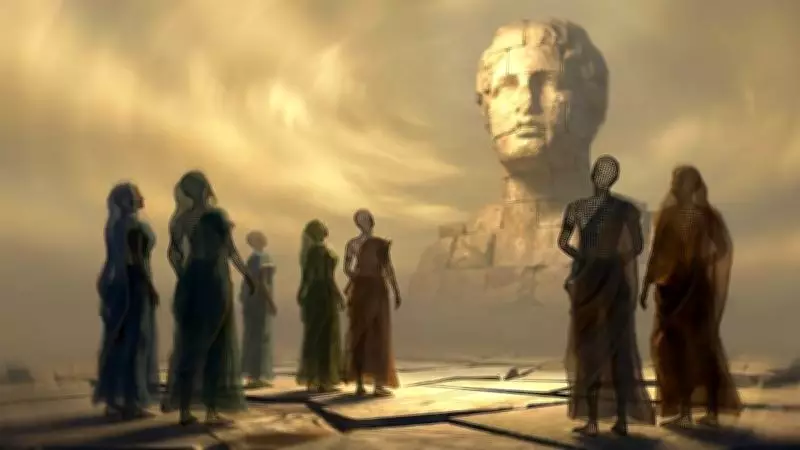
The Myth of the Lone Hero in Historical Narratives
History has long been framed as a saga dominated by exceptional individuals whose brilliance and courage supposedly steer the course of events. From Thomas Carlyle's influential work On Heroes, Hero-Worship, and the Heroic in History in the nineteenth century to Karl Marx's materialist conception of history, debates over the roles of individuals versus collective forces have profoundly shaped our understanding of power, agency, and societal change. Popular culture, especially through cinema, has overwhelmingly embraced Carlyle's perspective, portraying heroes as the primary engines of history. In contrast, professional historians have consistently challenged this view, arguing that such narratives distort reality, erase the contributions of collective labor, and reduce ordinary people to passive spectators rather than active agents of history.
Ancient Roots of Hero Worship
This fascination with heroic individuals is not a modern phenomenon. Greek epics, such as the Iliad, hinge on the wrath of Achilles and the cunning of Odysseus, while Roman tradition venerates founders like Romulus and Aeneas. In Persian literature, Ferdowsi's Shahnameh celebrates Rustam as a defender of Persia against chaos, and in Indian epics like the Mahabharata and the Ramayana, the valour of Arjuna and Rama's adherence to dharma shape the fate of kingdoms. Norse sagas elevate gods and warriors like Thor or Sigurd as arbiters of destiny. These narratives have naturalized the belief that civilizations rise and fall based on the will of singular men. Even when such figures embodied collective ideals, the structure of these stories suggested that history was intelligible through persons rather than peoples, laying the groundwork for Carlyle's "Great Man" theory.
Carlyle's Vision and Its Critics
Carlyle famously declared that the history of the world is "but the biography of great men," portraying leaders as world-historical forces whose insight and will reshape society. However, even his contemporaries offered robust challenges to this vision. Herbert Spencer observed that before a great man can remake society, society must first make him. Exceptional individuals arise from specific conditions—including institutions, cultural norms, economic structures, and historical circumstances. To credit them alone with transformation is to mistake effect for cause. Leo Tolstoy advanced this critique with unusual clarity and force in his novel War and Peace, where he explicitly dismantles the cult of the lone hero through characters like Napoleon and Tsar Alexander I. Both figures, celebrated in conventional histories as architects of Europe's fate, are stripped of mythic stature, revealing them as constrained by vast social forces rather than personal command.

Marxist and Structuralist Perspectives
Karl Marx formulated a parallel argument in systematic terms, asserting that humans make their own history but not under circumstances of their own choosing. Individuals act within inherited economic and social structures, with leaders mattering only insofar as they articulate and concentrate collective struggles. Revolutions, according to Marx, are not the achievements of solitary geniuses but the work of masses shaped by material conditions. In the twentieth century, historiography deepened this challenge to heroic explanations. Fernand Braudel and the Annales School emphasised the longue durée—geography, climate, trade routes, and social habits evolving over centuries—as the true engines of historical change, with rulers appearing as surface disturbances upon deeper currents. Marxist historians such as Eric Hobsbawm and E. P. Thompson further insisted that history is made by living men and women acting collectively within and against structures, with agency belonging to organised peoples rather than isolated figures.

Modern Cinema and the Persistence of Heroic Myths
Despite these critiques, mass culture continues to glorify the lone hero. Modern cinema repackages ancient myths for an industrial age, turning Carlyle's thesis into visual common sense. Superheroes from Superman to Captain America reshape global events through individual brilliance while institutions falter. Action franchises like James Bond and Rambo portray the courage and violence of a single figure as a decisive historical force. Bollywood mirrors this pattern, with films such as Sholay, where a village's fate rests on two heroic outsiders, and Dabang, where a lone policeman overwhelms corruption through personal strength. Turkish historical dramas like Diriliş: Ertuğrul similarly frame political transformation around the moral clarity and martial courage of a founding hero, presenting Ertuğrul Gazi as the pioneering figure whose vision lays the foundations of the Ottoman Empire. In each case, complex social processes are condensed into the will of one extraordinary individual, encouraging audiences to expect salvation from exceptional leaders rather than collective action.
Historical Evidence and Collective Agency
Historical evidence reinforces the understanding that greatness is socially constructed rather than intrinsic. Societies elevate certain figures to legitimise values such as conquest, tolerance, nationalism, or piety, with hero worship becoming an instrument of collective memory and power. For instance, Abraham Lincoln's emancipation rested on abolitionist agitation, Mahatma Gandhi's leadership drew strength from decades of anti-colonial mobilisation, and Martin Luther King Jr. voiced a mass civil rights movement. Similarly, figures like Lenin and Ho Chi Minh emerged as symbols of revolutions already underway. Literature and art often grasp this truth intuitively, with works by Tolstoy, John Steinbeck, Maxim Gorky, and Ngũgĩ wa Thiong'o celebrating collective struggle. Poetry, such as Percy Bysshe Shelley's The Mask of Anarchy, Faiz Ahmed Faiz's Hum Dekhenge, and Shaikh Ayaz's Sindhi verse, envisions history as the rising of the multitude.
Conclusion: The Danger of Heroic Narratives
The persistence of the Great Man narrative—from Achilles to Napoleon to modern screen heroes—reflects a deep human desire for saviours. Yet history repeatedly demonstrates that lasting change comes from ordinary people acting together. Leaders matter, but not as isolated geniuses; they are expressions, symbols, and sometimes catalysts of collective forces. History is not the biography of conquerors but the record of societies struggling, organising, resisting, and imagining new possibilities. The myth of the lone saviour is not only inaccurate but politically dangerous, as it encourages passivity and reinforces domination. The lesson is clear: history is the living record of the people, whose courage, labour, and collective will truly move the world.