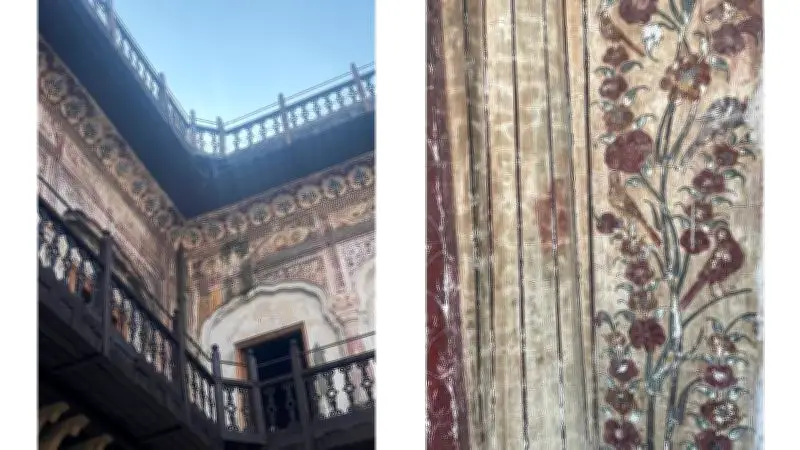
In the heart of Lahore’s historic Walled City, hidden behind bustling bazaars, tangled electric wires, and centuries of urban transformation, stands one of the city’s most extraordinary architectural treasures: Haveli Nau Nihal Singh. Built in the nineteenth century during the Sikh era, the haveli is celebrated for its elaborate woodwork, decorative brick façades, projecting balconies, and intricately painted interiors. Yet beyond its imposing architecture lies a quieter masterpiece—its fading frescoes.
The Significance of the Frescoes
These paintings, spread across ceilings, walls, and decorative niches, are among the finest surviving examples of mural art from nineteenth-century Punjab. Rich in colour, symbolism, and craftsmanship, they tell stories not only of a building but of a city shaped by diverse cultural influences. Today, however, many of these artworks are slowly disappearing, threatened by neglect, environmental damage, and the relentless passage of time. The deterioration of Haveli Nau Nihal Singh’s frescoes is more than the loss of decorative art. It is the gradual erasure of a visual archive that connects modern Lahore to its complex and multicultural past.
A Jewel of Sikh-Era Lahore
Named after Prince Nau Nihal Singh, grandson of Maharaja Ranjit Singh and heir to the Sikh Empire, the haveli was constructed during a period when Lahore was emerging as an important political and cultural centre. While much attention has been given to the military and political history of the Sikh period, the architectural legacy of the era remains comparatively understudied. The haveli stands as evidence of a vibrant artistic culture that flourished in nineteenth-century Punjab. Its architecture reflects a fusion of Mughal, Sikh, Rajput, and local Punjabi traditions. Delicate wooden carvings coexist with floral patterns, geometric motifs, and painted scenes that demonstrate the remarkable skill of artisans working in Lahore at the time.

The Language of Frescoes
To many visitors, the frescoes may appear as decorative embellishments. In reality, they are historical documents painted onto plaster. The murals feature intricate floral designs, stylised landscapes, ornamental borders, and motifs inspired by Persian, Mughal, and Punjabi artistic traditions. Together, they reveal how ideas, aesthetics, and cultural influences travelled across regions and communities. Unlike written records, which often reflect the perspectives of rulers and elites, visual art offers insight into everyday artistic expression. The frescoes preserve details about colour palettes, decorative preferences, and design techniques that might otherwise have vanished from the historical record. They also challenge simplistic narratives about South Asian history. The artwork found within Haveli Nau Nihal Singh demonstrates that artistic traditions rarely belonged to a single religious or political community. Instead, they evolved through centuries of interaction, adaptation, and exchange.
A Heritage Under Threat
Despite their significance, the frescoes face numerous threats. Moisture infiltration remains one of the most serious dangers. Water seeping through roofs and walls weakens plaster surfaces, causing paint layers to detach and crumble. Fluctuations in temperature and humidity further accelerate deterioration. Dust, pollution, and biological growth add additional stress to already fragile surfaces. In some areas, the damage is immediately visible. Colours that once glowed with remarkable vibrancy have become faint and uneven. Decorative details have blurred. Cracks spread across painted surfaces like scars, reminding visitors that heritage can disappear gradually and almost imperceptibly.
Human intervention can sometimes worsen the situation. Repairs carried out without specialised conservation expertise may inadvertently damage original materials. Modern paints, cement-based plasters, and poorly planned renovations often alter the historical character of heritage buildings while accelerating long-term deterioration. The challenge is not unique to Haveli Nau Nihal Singh. Across South Asia, countless historic structures face similar pressures. Yet the haveli’s frescoes are particularly vulnerable because mural paintings are among the most delicate forms of architectural heritage. Once lost, they cannot truly be recreated.

Why Preservation Matters
In a rapidly expanding city, some may question whether the preservation of old paintings deserves urgent attention. Lahore faces pressing concerns related to infrastructure, housing, pollution, and public services. Against such challenges, heritage conservation can appear secondary. However, preserving historic sites is not merely an exercise in nostalgia. Cities derive their identity from layers of accumulated history. Monuments, streetscapes, and artworks provide continuity between generations. They offer residents a sense of belonging and place that cannot be replicated through new construction alone. Heritage also contributes to cultural education. For students who study within the haveli’s walls, the building serves as a tangible connection to the city’s past. Every fresco and architectural detail provides an opportunity to engage with history beyond textbooks.
Moreover, cultural heritage possesses economic value. Historic districts around the world attract tourism, investment, and scholarly interest. Conservation should therefore be viewed not as a financial burden but as a long-term investment in cultural and economic sustainability.
Lessons from Successful Restoration
Recent conservation efforts in Lahore demonstrate that restoration can succeed when expertise, funding, and institutional commitment align. Projects undertaken in the Walled City have revived historic structures that once appeared beyond repair. Traditional techniques have been employed to restore decorative elements, stabilise damaged surfaces, and preserve original materials. These initiatives show that deterioration is not inevitable. What is needed is a sustained commitment rather than occasional intervention.
For Haveli Nau Nihal Singh, conservation must begin with comprehensive documentation of existing frescoes. High-resolution photography, condition assessments, and archival research can create detailed records before further deterioration occurs. Conservation specialists should be involved in developing strategies tailored to the building’s specific needs, while routine maintenance must become a continuous priority rather than an emergency response. Public awareness is equally important. Heritage survives when communities recognise its value. Educational programmes, exhibitions, and media coverage can help transform the haveli from a little-known monument into a widely appreciated cultural landmark.
The Responsibility of Memory
The frescoes of Haveli Nau Nihal Singh are not simply remnants of a bygone era. They are living testimonies to Lahore’s artistic achievements, cultural diversity, and historical complexity. Their fading colours remind us that heritage is inherently fragile. Buildings do not preserve themselves. Paintings do not survive through admiration alone. Conservation requires attention, resources, and collective responsibility. Every city must decide what aspects of its past deserve protection. In Lahore, where history is visible in every brick and alleyway of the Walled City, that decision carries particular weight. If the frescoes of Haveli Nau Nihal Singh continue to fade unnoticed, Lahore risks losing more than a collection of paintings. It risks losing part of its own story. And once such stories disappear from the walls that carried them for generations, recovering them becomes impossible.