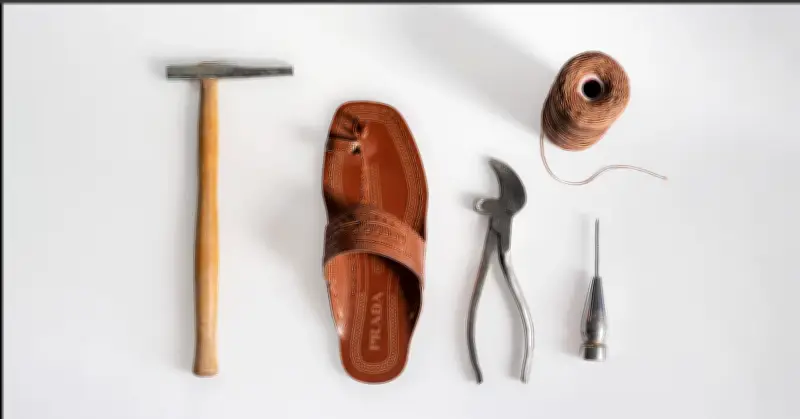
The renowned Italian luxury brand Prada recently launched a limited-edition line of sandals inspired by traditional Kolhapuri chappals. This collection was created in collaboration with local artisans from Maharashtra and Karnataka, the historic hubs of this craft. Priced at approximately €750 ($881), the line is being hailed as a major milestone for Indian craftsmanship on the global stage. However, this global recognition raises a pointed question: Why is credit exclusive to India for a heritage that is fundamentally shared?
The Shared Legacy of Kolhapuri Sandals
Kolhapuri sandals are more than just footwear; they are a 13th-century legacy. Known for their sturdy yet breathable leather structure, they were designed to suit the warm climate of the subcontinent. While they originated in Kolhapur, Maharashtra, the craft did not stay confined to modern borders. Following the 1947 Partition, many skilled artisans migrated to Pakistan, bringing their expertise with them. Today, Kolhapuri sandals are widely produced across Punjab and are a staple of casual Pakistani fashion.
How India Secured Global Recognition
The global fashion industry’s exclusive recognition of India is not accidental; it is the result of strategic legal and social action. In July 2019, Kolhapuri chappals were granted a Geographical Indication (GI) tag through the efforts of the Sant Rohidas Leather Industries & Charmakar Development Corporation Limited (LIDCOM). This tag provides a legal shield, ensuring the artistry cannot be imitated or claimed by unauthorised regions under international trade laws. Additionally, when Prada initially unveiled these designs without attribution, the Indian audience sparked a massive digital backlash. By labelling the move as cultural appropriation, they forced Prada to pivot, establish formal partnerships with Indian artisans, and issue proper credit.

Pakistan's Silence on Shared Heritage
While India and Pakistan share deep-rooted cultural ties and the same artisan origins, India dominates the global narrative because its institutions and citizens aggressively claim ownership of their heritage. Meanwhile, the Pakistani community has largely remained silent. We watch as our shared history is rebranded as an exclusive commodity of one nation. So, what can be done on our behalf?
Steps for Pakistan to Protect Its Cultural Assets
First, Pakistan must take ownership of its cultural assets through formal legal channels by applying for Geographical Indication (GI) tags for commodities—whether agricultural, traditional, or commercial—that are uniquely associated with its specific regions. To file for a GI tag, producers, processors, or distributors must apply through the Intellectual Property Organization of Pakistan (IPO-Pakistan). The applicant must fill out Form GI-01, which is available online, detailing the product's specifications and the reasons for its regional attribution. The application must be accompanied by an affidavit confirming compliance with the Book of Specifications, a consent letter from the registrant, and an application fee of Rs. 1,000 made out to the Director General of IPO-Pakistan.
In order to register a GI product in foreign countries, there are two options. The first is to apply directly to the targeted country, and they will proceed as per their GI systems. Alternatively, joining the Lisbon Agreement (Geneva Act) of 2015 under the World Intellectual Property Organization offers a more streamlined route. Member nations can file a single application with the World Intellectual Property Organization, which then coordinates the registration of the GI product across all other member countries. Pakistan is actively pursuing membership in this treaty. Joining will streamline the international application process, reducing both administrative hurdles and overall expenses.
Secondly, we must advocate for our craftsmen and pursue the same international legal protections for our regional variants of shared crafts. Only by taking a stand on the global stage can our artisans connect with luxury brands and receive the recognition, compensation, and dignity they deserve.