The King Salman Global Academy for Arabic Language (KSGAAL) in Riyadh has opened a groundbreaking exhibition titled "Arabic Language: Twenty-Eight Letters of Light." The exhibition offers a historical and intellectual journey through the development of Arabic, one of the world's oldest languages, using innovative technology and interactive displays.
Exhibition Highlights and Interactive Experience
The exhibition transforms the story of Arabic from traditional books and dictionaries into a dynamic, technology-driven experience. It features interactive stations where visitors can explore linguistic topics, engage with modern educational platforms, and participate in specialized training sessions. These sessions aim to enhance Arabic learners' skills, improve teaching methods, and present Arabic as a dynamic language capable of keeping pace with knowledge advances.
The exhibition also serves as a cultural landmark in Riyadh, reinforcing the status of Arabic while supporting the goals of Saudi Vision 2030 in the cultural, tourism, and heritage sectors. Technology-based exhibits trace the language's history, authenticity, and standing among the world's languages, highlighting its beauty, richness, and uniqueness.

Ancient Inscriptions and Writing Evolution
One section of the exhibition explores the history of languages in the Arabian Peninsula. It explains how scholars classify the world's languages into major families and how different linguistic approaches produce varying classifications. Many linguists place Arabic within the Hamito-Semitic language family, specifically among the Southwest Semitic languages, which include both Northern and Southern Arabic and the languages of the Arabian Peninsula. Semitic languages share common characteristics in sounds, vocabulary, morphology, and grammar. Many scholars believe Arabic is the closest surviving Semitic language to the ancient Proto-Semitic tongue.
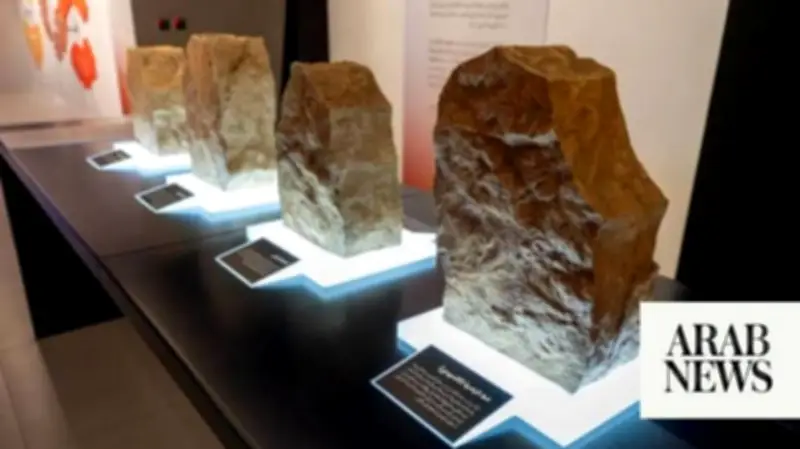
As spoken and written forms diverged, writing systems emerged across the Arabian Peninsula. Among the exhibits are authentic rock specimens bearing ancient inscriptions, including Thamudic and Nabataean scripts, preserved over centuries in rocks and valley walls as enduring evidence of the evolution of writing and language across Arabia.
Evolution of Writing Instruments and Materials
Another section traces the evolution of writing itself. Early civilizations wrote on stone, copper, wood, clay tablets, tree materials, camel shoulder blades and ribs, and leather. The exhibition explains how the Sumerians introduced the sharpened stylus in the early fourth millennium BC, using pointed wooden implements to inscribe soft clay tablets that were later dried in the sun. The stylus's wedge-shaped impression gave rise to cuneiform writing. Writing instruments continued to evolve, with different pens developed for specialized purposes.
During the Umayyad period, calligraphers Khalid ibn Abi al-Hayyaj and Qutbah al-Muharrir gained prominence, while the Abbasid era saw the rise of Ibn Muqlah, regarded as the master of Arabic calligraphy, and his student Ibn al-Bawwab. Over the centuries, Arab scholars developed detailed rules for holding and cutting pens and produced books devoted to writing instruments. Papermaking flourished during the Abbasid era, and Muslims were the first to introduce paper to Spain, paving the way for its spread across Europe.
Cultural and Scientific Context
The exhibition also serves as an advanced knowledge platform, presenting Arabic in its cultural and scientific contexts while showcasing Saudi Arabia's efforts to support the language, develop Arabic-language education, strengthen its presence in academic and scientific circles, and promote it globally. Through its interactive environment, visitors gain a deeper appreciation of Arabic's long history, its evolution through the centuries, and its contributions to thought, science, and the arts.

Ali Al-Ahmad, a doctoral researcher in philology, stressed that the exhibition succeeds in transforming the history and development of Arabic "from the dry theoretical setting of lecture halls and dissertations into a living, interactive space that engages the senses." "For us as researchers," he said, "the exhibition offers a different experience by integrating modern technology to tell the remarkable story of our language. Visitors almost feel that Arabic is a living organism, constantly evolving and responding to the changes in its environment." He added that seeing the roots of words, patterns of derivation, and semantic development presented through visual and interactive technological platforms "compresses years of traditional learning. The exhibition bridges the gap between the digital generation and the authenticity of the Arabic script, offering tangible proof that Arabic is fully capable of leading today's knowledge landscape, not merely keeping pace with it."