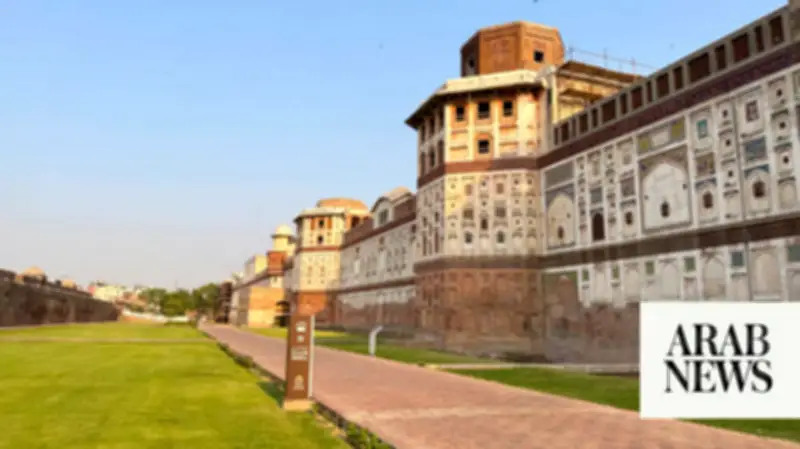
The Picture Wall at Lahore Fort, one of the largest surviving mural walls from the Mughal period, has been fully restored after more than a decade of conservation work, marking a significant achievement for heritage preservation in Pakistan.
UNESCO World Heritage Status Secured by the Wall
Rising nearly 17 meters (56 feet) and stretching approximately 475 meters (1,560 feet) along the fort's northern side, the monumental façade consists of nearly 2,000 individual panels depicting royal hunts, floral motifs, geometric designs, animals and scenes from courtly life. The artwork combines frescoes, brickwork and colorful glazed tile mosaics known as Kashi Kari.
“The Picture Wall is one of the principal reasons Lahore Fort was inscribed as a UNESCO World Heritage Site in 1981,” Khawaja Tausif Ahmad, chief executive officer of Aga Khan Cultural Service Pakistan, which carried out the restoration in partnership with the Punjab government and the Walled City of Lahore Authority, told Arab News. “Because of its size and complexity, no one had been able to fully undertake its restoration in the past,” he added. “Even where some interventions were made, they remained fragmented and the monument never regained its full visual impact.”

Complex Restoration Tackles Centuries of Decay
Built during the reign of Mughal emperor Jahangir in the early 17th century, the Picture Wall is around 400 years old. Over the centuries, the structure deteriorated significantly due to water seepage, poor drainage systems and exposure to weather. According to Ahmad, restoring the monument required far more than repairing decorative surfaces. “What appears to be a decorative conservation project was, in reality, much more complex,” he said. “It required extensive structural interventions and the redesign of drainage systems that had damaged the wall for decades.”
The project, which began in 2015, brought together architects, engineers, archaeologists, chemists, material scientists, conservators and artists. Experts from Germany, Switzerland, Sri Lanka and other countries provided technical guidance, while international partners including the US, German and Norwegian embassies supported various aspects of the initiative.
Research-Based Approach Pioneered in Pakistan
For conservation scientists, the project also marked an important shift toward research-based heritage preservation in Pakistan. Senior Conservation Scientist and Project Lead Zeina Naseer said the first phase focused on understanding the monument before any large-scale restoration work began. “We started with digital documentation of the entire wall and spent years studying the materials and testing different conservation methods,” she said. “The idea was to develop an approach based on research and evidence before any large-scale intervention began.”
She said the Picture Wall presented a unique challenge because there was no previous model in Pakistan for conserving a monument of such scale and complexity. “Traditionally, conservation here has often meant reconstruction, where damaged elements are replaced with new ones,” Naseer said. “That approach is easier because it does not necessarily require scientific analysis. For the Picture Wall, our priority was to preserve the original material and understand the monument's history through careful research.”
Training Ground for New Generation of Conservators
The restoration also became a training ground for a new generation of Pakistani conservators. Over the course of the project, architects, craftsmen and conservation specialists spent years developing skills that had rarely been applied on such a scale in Pakistan. Architect Sania Baig, who joined the initiative during work on one of the fort's towers, spent years documenting and digitally decoding architectural features ranging from glazed tiles and pigeon holes to structural cracks in domes. “We started with documentation because every intervention had to be based on evidence,” she said. “We studied the structures in detail, assessed the damage and carefully evaluated what should be preserved and how.”

Lead conservator Rahat Ullah spent the past eight years restoring decorative panels and geometric compositions on the wall. “We reconstructed and conserved hundreds of panels and worked extensively on frescoes, tiles and brickwork,” he said. “Every pattern had to be studied and understood before we could intervene.”
For senior craftsman Muhammad Naveed, the project continued a family connection to some of Pakistan's most important historic sites. His father spent his life working on monuments including Shalimar Gardens, Jahangir's Tomb and Lahore Fort. “I grew up watching him work on these monuments and naturally developed the same passion,” Naveed said. “For me, this place feels like a school. Every day here has been an opportunity to learn and to contribute to something much bigger than ourselves.”