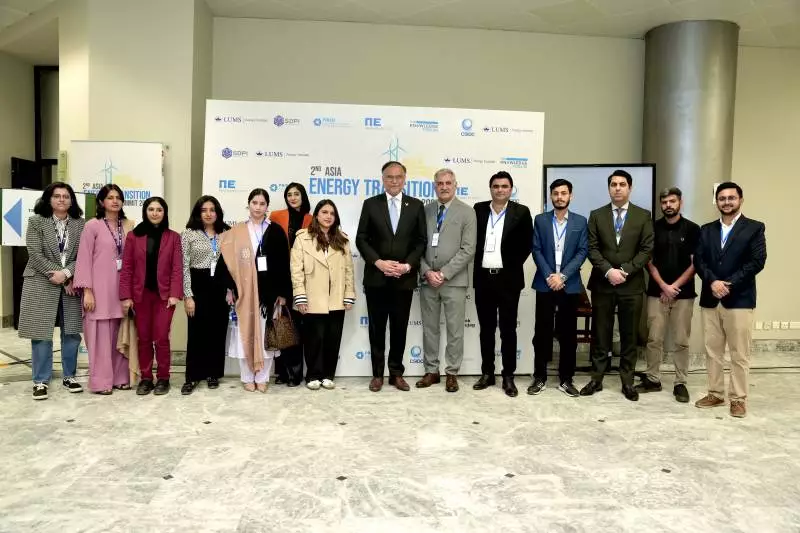
The prestigious Lahore University of Management Sciences (LUMS) became the focal point for a critical regional dialogue today as it hosted the opening of the Second Asia Energy Transition Summit. The event witnessed significant participation from across Asia, Europe, and the Pacific, bringing together a powerful assembly of government officials, diplomats, climate experts, development institutions, and civil society networks.
Ministerial Vision for a Sustainable Pakistan
In his inaugural address, Professor Ahsan Iqbal, the Federal Minister for Planning, Development and Special Initiatives, outlined the government's strategic roadmap. He emphasized the ongoing reforms designed to secure Pakistan's energy future, placing a resilient and forward-looking national grid at the core of these efforts. The minister described modern infrastructure as indispensable for building a green and competitive economy, stating that the government is actively strengthening power systems to accommodate large-scale renewable energy projects.
He powerfully noted that "the most reliable source of clean energy is the energy conserved," reaffirming the critical role of energy efficiency. Minister Iqbal also called for enhanced multilateral engagement and partnership-driven financing, stressing that no nation can navigate the complex energy transition alone.

Policy Focus on Modernization and Partnerships
The summit's discussions were guided by the policy vision of Federal Minister for Energy (Power Division), Awais Ahmad Leghari. Addressing the attendees, Minister Leghari confirmed that Pakistan's energy strategy is deeply rooted in sustainability and recognizes the urgent need to shift toward renewables. "To fully unlock the potential of renewable energy, Pakistan is focused on modernizing its energy infrastructure," he stated.
He elaborated that a smart and modernized grid is essential for effectively integrating renewable sources. Acknowledging the substantial investment required, Minister Leghari expressed Pakistan's openness to partnerships with international organizations, foreign governments, and private sector entities to collectively achieve a future powered by clean energy.
Legal, Financial, and Global Perspectives
The plenary dialogue featured insightful contributions from other eminent figures. Dr. Shamshad Akhtar, former Federal Minister of Finance, urged Asia to lead global transition debates with confidence, advocating for integrated planning that balances financial prudence with social equity.
Justice Syed Mansoor Ali Shah, former judge of the Supreme Court of Pakistan, highlighted the legal dimensions, asserting that climate and energy governance must be rights-based and transparent. He pointed out a critical gap, noting that "climate finance never matched the scale of climate challenge." Significantly, he shared that the Supreme Court has established a landmark precedent by ruling that access to climate finance is a fundamental right, as adaptation is impossible without it.
International delegates enriched the conversation with insights on financing, market reforms, and regional cooperation, underscoring the global interest in Asia's emerging leadership role. Thematic sessions tackled issues like tariff barriers, South-South cooperation, and the need for financing mechanisms that protect developing nations from unsustainable debt.
Commitment to Evidence-Based Pathways
Concluding the first day, Dr. Tariq Jadoon, Provost of LUMS, reaffirmed the university's dedication to advancing research-driven energy policy. Dr. Fiaz Chaudhry, Chairman of the National Grid Company and Senior Advisor at the LUMS Energy Institute (LEI), expressed confidence that the summit's outcomes would inform practical and financially viable pathways for aligning development with climate goals.
The summit, jointly organized by the LUMS Energy Institute (LEI), the Alliance for Climate Justice and Clean Energy (ACJCE), and the Pakistan Renewable Energy Coalition (PREC), continues tomorrow with high-level forums on financing, energy diplomacy, and distributed renewable energy deployment.