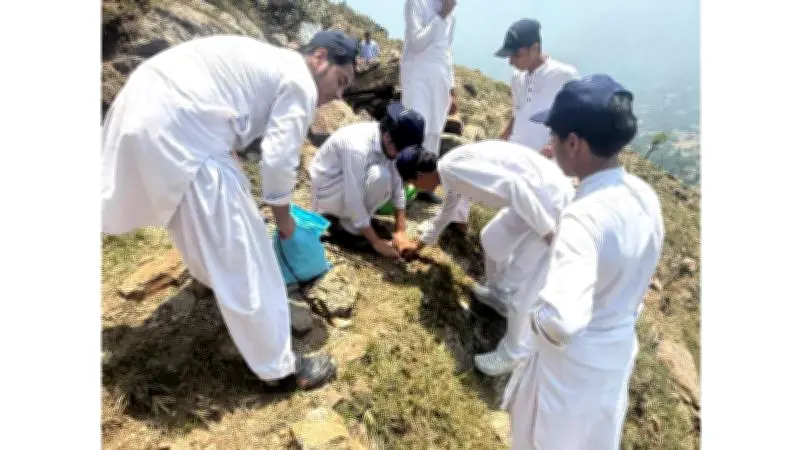
The monsoon season in Pakistan, once a time of vibrant green hills and rejuvenated streams, has become a source of deep anxiety due to climate change-induced heavy downpours and flash floods. In the Swat Valley, a community-based initiative at Government Higher Secondary School (GHSS) Kokarai is turning the tide by distributing approximately 3,000 seed balls among students, teachers, and volunteers. This campaign, inspired by Japanese natural farming pioneer Masanobu Fukuoka, aims to restore degraded slopes and transform the monsoon from a period of risk into a season of ecological restoration.
The Seed Ball Technique: A Simple Solution
Nearly a century ago, Masanobu Fukuoka observed that forests regenerated naturally without human intervention. He developed the seed ball technique: mixing seeds with clay and organic material into small balls that protect seeds from birds, insects, and harsh weather until rainfall softens the clay. This inexpensive method, popularized in his book The One-Straw Revolution, is ideal for inaccessible mountainous areas like Swat, where conventional planting is difficult. The hills of Swat provide an ideal setting for this approach, as many degraded slopes become inaccessible during the monsoon. Carefully prepared seed balls containing indigenous tree and shrub species can help restore vegetation in these hard-to-reach areas.
Community Mobilization at Kokarai
The campaign at GHSS Kokarai encouraged young people to become active participants in ecological restoration. What began as an effort by a handful of local citizens proved that meaningful change does not require large government budgets or international conferences. The seed ball teaches patience: a seed does not become a forest overnight, and lasting change requires sustained commitment across many years. Alongside the boys' school, a parallel campaign took place at Government Girls Higher Secondary School (GGHSS) Kokarai, where female students worked with mobilizers from the Forest Department to prepare seed balls and learn ecological care. This demonstrated that environmental resilience is a shared duty, and empowering young women with practical skills transforms them into guardians of their home ecosystems.

The Spiritual Significance of Trees
Across cultures and religions, trees symbolize life, wisdom, and renewal. In Islamic tradition, the Prophet Muhammad (peace be upon him) taught: "If the Resurrection were established upon one of you while he has a sapling in his hand, then if he is able to plant it before he stands up, let him do so." This underscores greening the earth as a duty of absolute hope. In Buddhism, Siddhartha Gautama attained enlightenment beneath the Bodhi tree. In Islam, Christianity, Hinduism, and Sikhism, trees are associated with divine blessings and humanity's responsibility to care for creation. Respect for nature is inseparable from respect for life.
The Kokarai Declaration: A Community Pledge
The ideas from Kokarai deserve to inspire schools across Khyber Pakhtunkhwa and Pakistan. The vision, known as the Kokarai Declaration, is a community pledge to restore the relationship between people and nature. Its principles include treating the monsoon as a season of restoration, making environmental fieldwork an essential part of education, protecting existing forests, restoring flood-affected landscapes through scientifically planned plantation, conserving indigenous seeds and traditional knowledge, establishing community nurseries and seed banks, encouraging every student to become the lifelong guardian of at least one tree, and building partnerships among government institutions, universities, civil society, and international networks. These ambitions require commitment more than capital, cooperation more than bureaucracy, and vision more than slogans.

Opportunity for the Malala Fund
For local success like Kokarai to protect the region, it needs to spread across every village. The Malala Fund, with deep roots in Swat Valley, could support targeted environmental leadership programs for female students across public schools. Funding could train female students in raising plant nurseries, creating school-led community seed banks, and leading local conservation awareness. Giving young women these practical skills builds confidence and ensures that practical care becomes part of daily life. As the article states, "When you teach a young woman how to restore the land, that knowledge stays inside the home and benefits the entire family."
Conclusion: Every Monsoon as an Opportunity
History honors those who meet crisis with courage and action. One village school cannot stop global climate change, but every great forest begins with a single seed. The monsoon places a clear choice: continue counting losses after every flood, or begin counting the hillsides greened, springs brought back to life, and young minds inspired. Planting a tree means planting clean air, safer villages, better livelihoods, and a safer future for children.