Pakistan’s youth unemployment rate stands at 9.5%, with young women facing rates 5.9 percentage points higher than men (World Bank, 2024; ILO, 2025). Yet these figures do not exist in the absence of institutional intervention. Since 2010, the Punjab Skills Development Fund (PSDF) has trained over 300,000 underprivileged youth across all 36 districts of Punjab. The infrastructure of opportunity exists, but many of the people who need it most remain unable to access it. This contradiction raises an important question: if opportunities are available, why do so many young people remain disconnected from them?
While volunteering at Zahoor Ahmad School, an institution serving underprivileged students, it became clear that the primary issue was not a lack of talent or education, but a lack of opportunity. Many students were unaware that vocational training pathways even existed. Parwaaz-e-Hunaar, developed in collaboration with Zahoor Ahmad School and PSDF, sought to bridge this gap by connecting students directly with skill development opportunities and the job market.
Understanding Structural Unemployment
The challenge these students face is best understood through structural unemployment: a mismatch between the skills workers possess and those demanded by the labour market. As Punjab’s economy increasingly shifts toward skilled services and technical work, many young people remain disconnected from emerging opportunities. PSDF was established to address this challenge and now offers training in over 250 demand-driven trades. The problem, however, is no longer the existence of programmes but access to them.

PSDF's Impact and Barriers
Established through collaboration between the Government of Punjab and the UK’s Foreign Commonwealth and Development Office, PSDF has trained over 110,000 women and 180,000 men. Research by Raza and Akram (2024) found that its programmes improve employability while also highlighting barriers related to accessibility and equity. If students with internet access can struggle to navigate enrolment systems, the challenge is even greater for those with limited resources and awareness.
Parwaaz-e-Hunaar: Reversing the Model
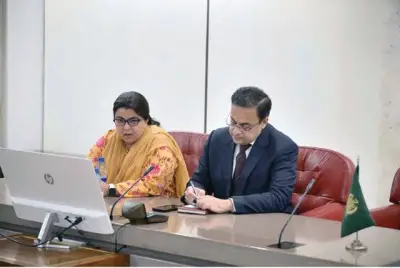
Parwaaz-e-Hunaar addressed this challenge by reversing the traditional model. Rather than expecting students to find PSDF, PSDF was brought directly to them. Following discussions with the institute, a workshop was held on the 3rd of March, where representatives introduced training opportunities, answered questions, and distributed registration forms. The partnership was later formalised through a Memorandum of Understanding on the 14th of April, ensuring long-term collaboration between the school and PSDF.
Sustainability and Broader Lessons
The initiative also highlighted a broader lesson about sustainability. Structural unemployment cannot be solved through isolated workshops alone. Lasting change requires stronger outreach, more accessible enrolment systems, and institutional partnerships with under-resourced schools. Parwaaz-e-Hunaar is not a complete solution, but it demonstrates that the barrier was never willingness—it was accessibility. When communities are directly approached and informed, they respond.
For many young people, limited access to skills development means limited access to independence, opportunity, and social mobility. Sustainable development begins not simply by creating opportunities, but by ensuring they are reachable. When one student gains access to vocational training, the impact extends beyond the individual, helping break cycles of poverty and creating opportunities for future generations.

References
- International Labour Organization. (2024). Global employment trends for youth 2024. ILO.
- International Labour Organization. (2025). World employment and social outlook: Trends 2025. ILO.
- Mankiw, N. G. (2021). Macroeconomics (11th ed.). Worth Publishers.
- Pasha, A., et al. (2024). Pakistan and its approach to information technology (IT) revolution — A case study of Punjab Skills Development Fund (PSDF). In EDULEARN24 Proceedings (pp. 10450–10454). IATED.
- Punjab Skills Development Fund. (n.d.). About PSDF.
- Raza, M. A., & Akram, M. (2024). Employment generation through skills development: Measuring effectiveness of the Punjab Skills Development Fund in enhancing employability. Journal of Policy Research, IX(IV), 132–144.
- World Bank. (2024). Youth unemployment rate for Pakistan [Data set]. Federal Reserve Bank of St. Louis / FRED.
- World Economic Forum. (n.d.). Punjab Skills Development Fund (PSDF).